Distinguish true technology of Multiplex Assay Kits from physically-assembled ELISAs panel products
HUSTON, TX, UNITED STATES, August 26, 2026 /EINPresswire.com/ — As researchers aim to acquire data for multiple analytes from limited biological samples, multiplex biomarker detection has become an essential tool for immunology, inflammation and disease-mechanism research. Nevertheless, the market hosts various seemingly cost-effective “multiplex assay kits” that are simply physical combinations of single-analyte ELISA assays. Such assembled products can mislead researchers and trigger irreversible consequences including loss of precious samples and unreliable experimental data. Cloud-Clone outlines the core distinctions between genuine liquid-phase multiplex technology and patch-work ELISA panels, offering practical selection references for researchers worldwide.
I. What is Partition-Assembled ELISA? Why Is It “Pseudo-Multiplex Assay Kits”?
Partition-assembled ELISA works on a simple principle: capture antibodies for different analytes are coated onto separate rows or columns of a single 96-well plate. For detection, the same sample must be dispensed into multiple independent wells. The number of reaction wells required equals the number of target analytes to be measured.
This product only physically consolidates several independent ELISA systems onto one plate without chemical-level technical integration. Reactions in each well remain separate single-analyte ELISA tests that merely share the same plate and chromogenic substrate. It does not represent genuine simultaneous multiplex detection.
II. Three Critical Drawbacks of Patch-work Products: Notable Limitations for Research
Drawback 1: No Sample-Saving Benefit — N-fold sample volume is needed for N analytes
Genuine mature multiplex technologies, such as Luminex liquid-phase suspension microsphere assays, employ distinct encoded microspheres within one single reaction well to capture multiple targets simultaneously. Only 25 μL of sample is enough to quantify more than a dozen analytes in one run.
By contrast, partition-assembled ELISA requires sample aliquoting into 12 separate wells for 12 analytes. For precious samples such as cerebrospinal fluid or mouse plasma, limited sample volume will be rapidly consumed. It becomes difficult to set biological replicates or preserve material for follow-up validation experiments.
Core pain point: It fails to address the most critical challenge of multiplex detection — sample scarcity.
Drawback 2: Lack of Cross-Interference Validation, Questionable Data Comparability
Commercial mature liquid-phase multiplex kits are supplied with complete cross-reaction validation documentation from manufacturers, verifying the absence of mutual interference among analytes in mixed-assay conditions.
For partition-assembled ELISA, antibodies are coated independently in each well. No joint validation is performed under mixed-matrix conditions. Interactions between different analytes and antibodies within sample matrices remain unconfirmed. Data generated from separate wells originate from independent reaction conditions, which creates fundamental flaws when directly applied for correlation or network analysis.
Drawback 3: Compromised Performance: Inferior Precision vs. Single-Analyte ELISA, Lower Throughput vs. Liquid-Phase Multiplex Assay Kitss
– Compared with single-analyte ELISA: Patch-work plates are prone to edge effects and intra-plate well-to-well deviations, delivering lower detection precision than running independent single-analyte ELISA tests. – Compared with liquid-phase micro-bead assays (Luminex / CBA): There is a substantial throughput gap. Liquid-phase solutions return results for all analytes with a single sample loading step.
Partition-assembled ELISA occupies an awkward intermediate position: less precise than single-analyte ELISA, far less efficient than liquid-phase Multiplex Assay Kitss, while offering no sample-consumption advantage. It is a typical transitional solution with compromises on both fronts.
III. Liquid-Phase Suspension Microsphere Assay: Recognized Gold Standard for True Multiplex Detection
To identify pseudo-multiplex products, it is necessary to understand the working principle of liquid-phase suspension microsphere assay, the mainstream multiplex technology.
Core Technical Principle
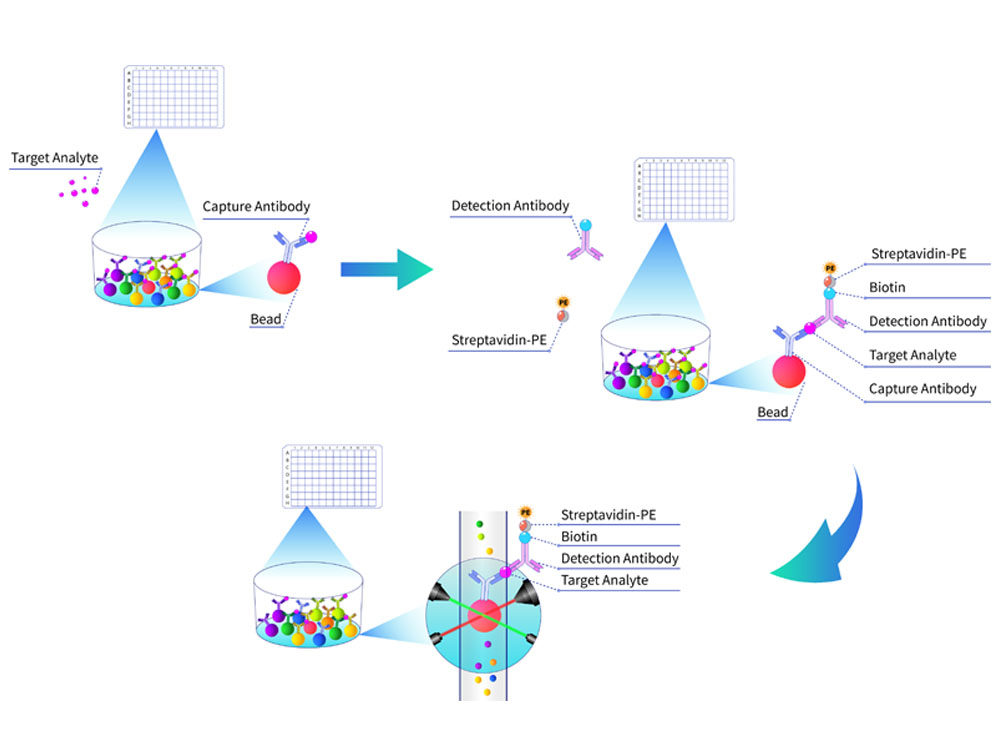
Liquid-phase suspension microsphere assays rely on fluorescence-encoded microspheres for multiplex measurement. By adjusting the ratio of two red fluorescent dyes, polystyrene microspheres (~5.6 μm diameter) are labelled with hundreds of unique fluorescence codes. Each type of encoded microsphere corresponds to one detection target, assigning a unique “ID” to each analyte.
Full experimental workflow:
1.Antibody conjugation: Capture antibodies against distinct targets are covalently coupled to uniquely encoded microspheres.
2.Mixed incubation: All encoded microspheres are combined. One aliquot of sample (25-50 μL only) is added, and multiple analytes are captured synchronously within the same reaction system.
3.Sandwich-complex formation: Biotin-labelled detection antibodies are introduced to form immune complexes of “microsphere-capture antibody-target analyte-detection antibody”.
4.Dual-laser readout: A red laser identifies microsphere codes to determine analyte identity; a green laser measures fluorescence signal intensity to quantify analyte concentration.
Figure 1 Principle of Cloud-Clone Multiplex Assay Kits
Core Technical Advantages
– High throughput: 2-100 analytes can be measured in a single reaction well
– Minimal sample input: Only 25-50 μL sample volume required – High sensitivity: Limit of detection down to 0.01 pg/mL
– Broad dynamic range: Spanning 3.5-6 orders of magnitude, enabling simultaneous quantification of both high- and low-abundance analytes
– High flexibility: Microspheres can be freely combined to support custom-built assay panels
This technical platform has obtained FDA clearance for clinical diagnostic applications. Relevant findings have been published in Nature, making it one of the most widely cited gold-standard multiplex-detection solutions globally.
Overview of Mainstream Global Multiplex-Detection Technologies
Three major multiplex-detection technologies dominate the industry: Luminex liquid-phase suspension microsphere assay, flow-based CBA, and MSD electrochemiluminescence. They differ in principles, performance and application scenarios.
1.Luminex liquid-phase suspension microsphere assay (xMAP®): Highest throughput, supporting 2-100 analytes per well with pg-level sensitivity. Representative brands: R&D Systems, Thermo Fisher, Bio-Rad, Cloud-Clone. Widely referenced in scientific publications.
2.Flow-based CBA (Cytometric Bead Array): Compatible with standard flow cytometers with no dedicated additional instruments required, lowering entry barriers. Representative brands: BD, Cloud-Clone, BioLegend.
3.MSD electrochemiluminescence: Delivers the highest sensitivity among the three platforms (fg/mL level), with a 5-6-order-of-magnitude dynamic range and strong anti-matrix-interference capacity. It is well-suited for complex samples such as cerebrospinal fluid. Limitations include a maximum of 10 analytes per well and high overall costs for instruments and reagents. Representative brand: Meso Scale Discovery.
Quick selection tips: Choose Luminex for high throughput and publication compatibility; choose flow-based CBA for instrument compatibility and cost control; choose MSD for ultra-high-sensitivity measurement of complex-matrix samples.
Key distinction: All above-mentioned mature technologies complete multi-target detection from one sample within one unified reaction system. Partition-assembled ELISA runs separate reactions in divided wells, representing a fundamental technical gap.
Cloud-Clone ranks among the few suppliers worldwide with full in-house manufacturing capacity covering both Luminex and flow-based CBA platforms.
Figure 2 Cloud-Clone Luminex Multiplex Detection Platform
IV. Cloud-Clone: Decades-Long Expertise Delivering Authentic Multiplex Detection Solutions
Cloud-Clone has accumulated nearly 20 years of experience in multiplex biomarker detection. We deploy globally validated liquid-phase suspension microsphere technologies including the Luminex® xMAP and flow-based CBA dual platforms, the gold-standard multiplex-research solutions for life-science studies.
Technical logic: Each analyte matches one uniquely fluorescence-encoded microsphere. Mixed microspheres are incubated with a single sample in the same reaction well. With merely 25 μL starting material, multiple analytes can be quantified simultaneously. This reduces sample consumption and experimental time while generating comparable datasets.
Built upon years-of-technology iteration, Cloud-Clone’s system features:
– Self-produced antibody and protein raw materials: Quality and cost are controlled at the source, avoiding risks from compromised raw-material used in low-cost products.
– Complete cross-reaction-validation workflow to ensure no inter-analyte interference during multiplex measurement.
– Dual-platform compatibility: Works with common flow cytometers and dedicated Luminex analyzers to accommodate diverse laboratory hardware configurations.
– More than 7 000 analytes covering over 10 species, supporting custom-built panels beyond fixed preset combinations.
Figure 3 Cloud-Clone Flow-Based CBA Multiplex Detection Platform
V. Practical Multiplex-Detection Selection Guide
Table 1 Decision matrix for multiplex protein‑assay selection according to experimental requirements.
Important Reminder: Avoid partition-assembled ELISA panels Products marketed as “Multiplex Assay Kitss” by physically assembling separate single-analyte ELISA onto one plate carry three major drawbacks: – Sample must be aliquoted into different wells; N-fold sample volume is consumed for N analytes. – Without cross-interference validation, data comparability cannot be guaranteed. – Lower precision than single-analyte ELISA and far inferior throughput compared with liquid-phase multiplex platforms.
Quick-reference checklist: – ≤3 targets with abundant samples → Single-analyte ELISA for reliable data – ≥4 targets, limited sample + Luminex hardware → Luminex for maximum throughput – ≥4 targets, limited sample + no Luminex hardware → Flow-based CBA – Partition-assembled ELISA panels → Not recommended
VI. Closing Thoughts
The highest experimental costs are not assay kits themselves, but irreplaceable biological specimens and valuable research time.
Patch-work ELISA panels may appear cost-effective. Nevertheless, they waste precious samples and produce questionable datasets. Improper assay selection leading to failed experiments can delay your entire research project.
Cloud-Clone multiplex kits are built on mature liquid-phase microsphere technology. One sample, one loading step, reliable simultaneous quantification of multiple biomarkers. We reject misleading physical-assembly shortcuts and deliver reproducible data for researchers worldwide.
Should you have questions about assay selection for your study, please feel free to contact us for personalised technical consultation. Choosing the right assay solution lays the foundation for successful research.
About Cloud-Clone Corp.
Cloud-Clone Corp. is dedicated to the development and production of high-quality immunoassay reagents and detection solutions. With a focus on antibody engineering, multiplex assay development, and cross-platform compatibility, the company provides research tools designed to support precision medicine and advanced biomedical investigation globally. Our core products and services include the research and development of proteins, antibodies, ELISA kits, primary cells, and multiplex cytokine assay kits, as well as professional CRO services to fully meet the diverse needs of biomedical research and related fields.
For more information about Cloud-Clone Corp, visit www.cloud-clone.com.
CLOUD-CLONE CORP.(CCC)
Tel: 001-832-538-0970, 0086-27-8425-9552
Email: mail@cloud-clone.com, sales@cloud-clone.us
Visit us on social media:
LinkedIn: https://www.linkedin.com/company/cloud-clone-corp/
Instagram: https://www.instagram.com/cloudclonecorp2023/
TickTok: https://www.tiktok.com/@cloudclonecorp2026
SuKi Duan
CLOUD-CLONE CORP.WUHAN
email us here
Visit us on social media:
LinkedIn
Instagram
TikTok
X
Legal Disclaimer:
EIN Presswire provides this news content “as is” without warranty of any kind. We do not accept any responsibility or liability
for the accuracy, content, images, videos, licenses, completeness, legality, or reliability of the information contained in this
article. If you have any complaints or copyright issues related to this article, kindly contact the author above.

Media gallery