Decoding the cardiac cellular universe: primary cell resources for dissecting heart microenvironment-driven disease mechanisms
HUSTON, TX, UNITED STATES, August 26, 2026 /EINPresswire.com/ — Cardiovascular research is increasingly moving beyond studying cardiomyocytes in isolation, toward understanding the complex multicellular crosstalk that shapes cardiac physiology and pathology. Pathological alterations in heart diseases rarely stem from dysfunction of a single cell type. Instead, they arise from cascading interactions among diverse cell populations within the cardiac microenvironment. To help researchers establish in-vitro systems that better recapitulate real-life physiological conditions, Cloud-Clone has built a comprehensive portfolio covering seven major categories of primary cardiac cells, delivering robust tools for cardiovascular mechanistic exploration, drug screening and translational research.
The “Cellular Universe” of the Heart: Dissecting the Cardiac Microenvironment to Unlock Disease Truths
Far more than a simple biological pump, the heart operates as a sophisticated micro-ecosystem driven by precise collaboration and intercellular communication among multiple cell types. Cardiomyocytes execute blood-pumping functions, yet their health and function are profoundly influenced by neighboring cells including microvascular endothelial cells, fibroblasts and mesothelial cells. To truly understand cardiac physiology and investigate disease mechanisms, researchers must avoid studying individual cell types in isolation and reconstruct the physiologically relevant multi-cell microenvironment.
Specializing in primary cell development, Cloud-Clone leverages its in-house SPF-grade animal facilities and ISO-certified quality control system to deliver a full-microenvironment portfolio of primary cardiac cells: cardiomyocytes, cardiac microvascular endothelial cells, cardiac fibroblasts, pericardial fibroblasts, cardiac valve interstitial cells, pericardial mesothelial cells and endocardial fibroblasts. From a fresh perspective centered on cell-to-cell crosstalk and microenvironment reconstruction, Cloud-Clone redefines the practical value of primary cardiac cells for research.
I. Cardiomyocytes (MC): The Contractile Protagonists, Not Isolated Units
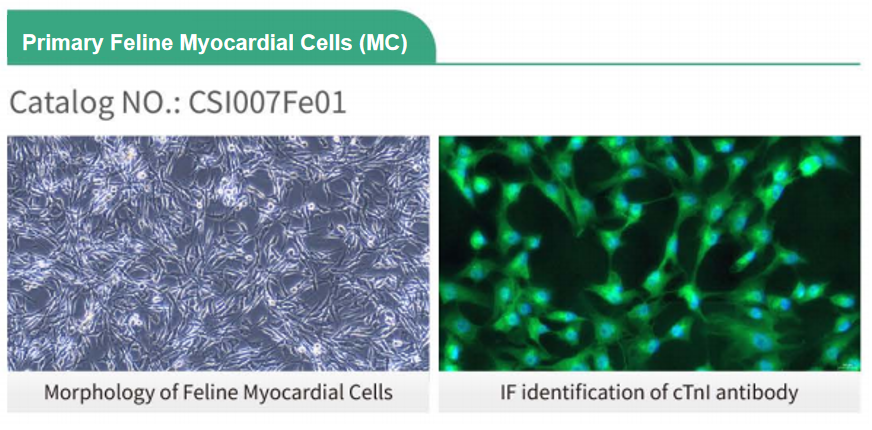
Primary cardiomyocytes serve as the cornerstone for cardiac function research. Cloud-Clone provides primary cardiomyocytes derived from rats, mice, rabbits, dogs, cats, pigs, sheep, chickens and other species. Feline cardiomyocytes (Catalog No. CSI007Fe01), for instance, are isolated via enzymatic digestion combined with differential adhesion. They achieve purity above 85% and viability over 80%, while retaining spontaneous rhythmic beating properties, making them suitable for long-term drug mechanism and toxicology studies.
Nevertheless, cardiomyocyte phenotypes are heavily modulated by their microenvironment. Studies demonstrate that under stretch stimulation, cardiac fibroblasts and microvascular endothelial cells secrete factors such as angiotensin-Ⅱ and endothelin, which strongly trigger cardiomyocyte hypertrophy. This indicates that studies of cardiomyocyte hypertrophy using pure cardiomyocyte monocultures may overlook the critical paracrine regulation exerted by stromal cells.
Key Applications: – Myocardial ischemia/reperfusion injury models: Primary cardiomyocytes faithfully recapitulate pathological responses to hypoxia-reoxygenation injury for evaluating cardioprotective drug effects – Cardiotoxicity screening for drug candidates: Multi-species options support cross-species difference assessment and mitigate pre-clinical research risks – Multicellular co-culture systems: Co-culture of cardiomyocytes with fibroblasts and endothelial cells to model hypertrophy triggered by mechanical stress
II. Cardiac Microvascular Endothelial Cells (CMEC): Gatekeepers for Nutrition and Signaling
Cardiac microvascular endothelial cells function not only as barriers for nutrient exchange but also as core hubs for angiogenesis, inflammatory regulation and paracrine signaling. Cloud-Clone supplies cardiac microvascular endothelial cells from cats, dogs, rats, rabbits and other species.
Core Functional Features: – Secrete vasoactive substances (e.g. nitric oxide, endothelin) to regulate vascular tone and permeability – Damage and activation of microvascular endothelial cells represent one of the initiating events for target-organ injury in hypertension – Form functional units together with cardiac fibroblasts and cardiomyocytes: stretch stimulation triggers endocrine activation of microvascular endothelial cells and initiates cardiomyocyte hypertrophy
Key Applications: – Mechanisms of hypertensive target-organ damage: Explore crosstalk between endothelial injury and cardiac microenvironment imbalance – Angiogenesis and myocardial repair: Evaluate pro-angiogenic drug candidates for repairing ischemic myocardium – Drug impacts on microcirculation: Screen candidate compounds that preserve microvascular endothelial function
III. Cardiac Fibroblasts (CF): Architects of Cardiac Fibrosis
As the most abundant non-cardiomyocyte population in the heart, cardiac fibroblasts get activated, proliferate and trans-differentiate into myofibroblasts upon myocardial injury, acting as central mediators of cardiac fibrosis. Cloud-Clone offers cardiac fibroblasts from rats, mice, rabbits, dogs and other species.
Key Research Notes: – Cardiac fibroblasts account for approximately 40% of total cells in myocardial tissue and constitute the dominant stromal cell population within the heart – Ang-Ⅱ stimulation induces phenotypic and functional abnormalities in cardiac fibroblasts, driving myocardial fibrosis in hypertension – Modulate cardiomyocyte function via paracrine secretion of angiotensin-Ⅱ, endothelin, TGF-β and other mediators
Key Applications: – Mechanistic studies of cardiac fibrosis: Molecular dissection of TGF-β/Smad-driven fibroblast activation – Anti-fibrotic drug screening: High-throughput assessment of compound effects on fibroblast proliferation, migration and collagen synthesis – Cardiac remodeling models: Co-culture with cardiomyocytes to investigate paracrine effects of fibroblasts in pressure-overload-induced cardiac hypertrophy
IV. Pericardial Fibroblasts (PF) and Pericardial Mesothelial Cells (PeMC): Defenders of the Cardiac Outer Coat
Beyond functioning as a physical wrapping barrier for the heart, the pericardium is a biologically active tissue layer. Pericardial fibroblasts and pericardial mesothelial cells jointly maintain homeostasis within the pericardial cavity microenvironment.
Key Research Notes: – Proliferation and phenotypic transformation of pericardial interstitial cells (PICs) stand as core pathological events in pericardial fibrosis. Research shows that Krüppel-like factor 4 (KLF4) inhibits TGF-β1-driven proliferation and phenotypic shift of pericardial interstitial cells through the PI3K/Akt signaling pathway, identifying a novel target for anti-fibrotic therapies.
Key Applications: – Mechanisms of constrictive pericarditis: Explore molecular pathways and intervention strategies for pericardial fibrosis – Target discovery for pericardial diseases: Screen anti-fibrotic compounds using pericardial fibroblasts and mesothelial cells – Crosstalk between the pericardial cavity microenvironment and the heart: Investigate how pericardium-derived signals influence myocardial performance
V. Cardiac Valve Interstitial Cells (CVIC): Guardians of Valve Health
Normal cardiac valve function heavily relies on homeostatic maintenance of valve interstitial cells. Activation and osteogenic-like phenotypic transition of valve interstitial cells serve as critical drivers of calcific aortic valve disease. Cloud-Clone provides cardiac valve interstitial cells from dogs, sheep, rats, rabbits and more species.
Key Applications: – Mechanisms of calcific valve disease: Study signaling pathways mediating inflammation- and mechanical-stress-induced osteogenic differentiation of valve interstitial cells – Valve tissue engineering: Supply seed cells for constructing biological heart valves – Anti-calcification drug screening: Assess compound efficacy in interfering with valve interstitial cell calcification
VI. Endocardial Fibroblasts (EnCF) and Epicardial Fibroblasts (EPCF): Microenvironment Regulators of the Heart’s Inner and Outer Lining
Endocardial and epicardial fibroblasts form major supporting structures for the heart’s inner and outer surfaces respectively. Cloud-Clone supplies endocardial fibroblasts from dogs, sheep, rats and rabbits, as well as epicardial fibroblasts from dogs and rabbits.
Key Applications: – Endocardial / epicardial development and regeneration: Uncover fibroblast roles in cardiac development and post-injury repair – Pathological mechanisms of endocarditis and epicarditis: Investigate fibroblast activation and tissue remodeling under inflammatory conditions
VII. Multi-Species Portfolio: One-Stop Cell Resource Library from Basic to Translational Research
Cloud-Clone’s cardiovascular primary cell collection covers more than ten species: rat, mouse, rabbit, dog, cat, pig, sheep, guinea pig, chicken and human. This cross-species panel delivers unique advantages: – Rodents: Ideal for high-throughput mechanistic research and gene-editing validation – Large animals including dogs, pigs and sheep: Their physiological anatomy closely resembles humans, making them ideal pre-clinical models for medical device evaluation and stem-cell-based therapy validation – Feline-derived cells: Rare research tools for feline cardiovascular disease studies and veterinary drug development – Guinea pigs: Partially recapitulate human physiology and inflammatory responses, offering irreplaceable value for selected cardiovascular pharmacological studies
Shifting from single-cell usage toward microenvironment reconstruction, Cloud-Clone’s portfolio of primary cardiac cells unlocks the heart’s cellular universe for researchers. More than just cell products, Cloud-Clone delivers complete research solutions covering full anatomical compartments of the heart, broad species selection and end-to-end quality control.
Closing Remarks
For cardiovascular researchers worldwide, Cloud-Clone keeps expanding its primary-cell product portfolio. The company aims to lower technical barriers for building in-vitro cardiac microenvironment models and drive breakthroughs in basic medical science, new-drug development and translational medicine. Researchers may visit the official Cloud-Clone website (www.cloud-clone.com.cn) to check real-time inventory, quality-control parameters and supporting technical documents for its cardiac primary-cell line. Cloud-Clone looks forward to collaborating with global research peers to unravel the deep-seated mysteries of cardiac biology and advance cardiovascular research.
SuKi Duan
CLOUD-CLONE CORP.WUHAN
email us here
Visit us on social media:
LinkedIn
Instagram
TikTok
X
Legal Disclaimer:
EIN Presswire provides this news content “as is” without warranty of any kind. We do not accept any responsibility or liability
for the accuracy, content, images, videos, licenses, completeness, legality, or reliability of the information contained in this
article. If you have any complaints or copyright issues related to this article, kindly contact the author above.

Media gallery